
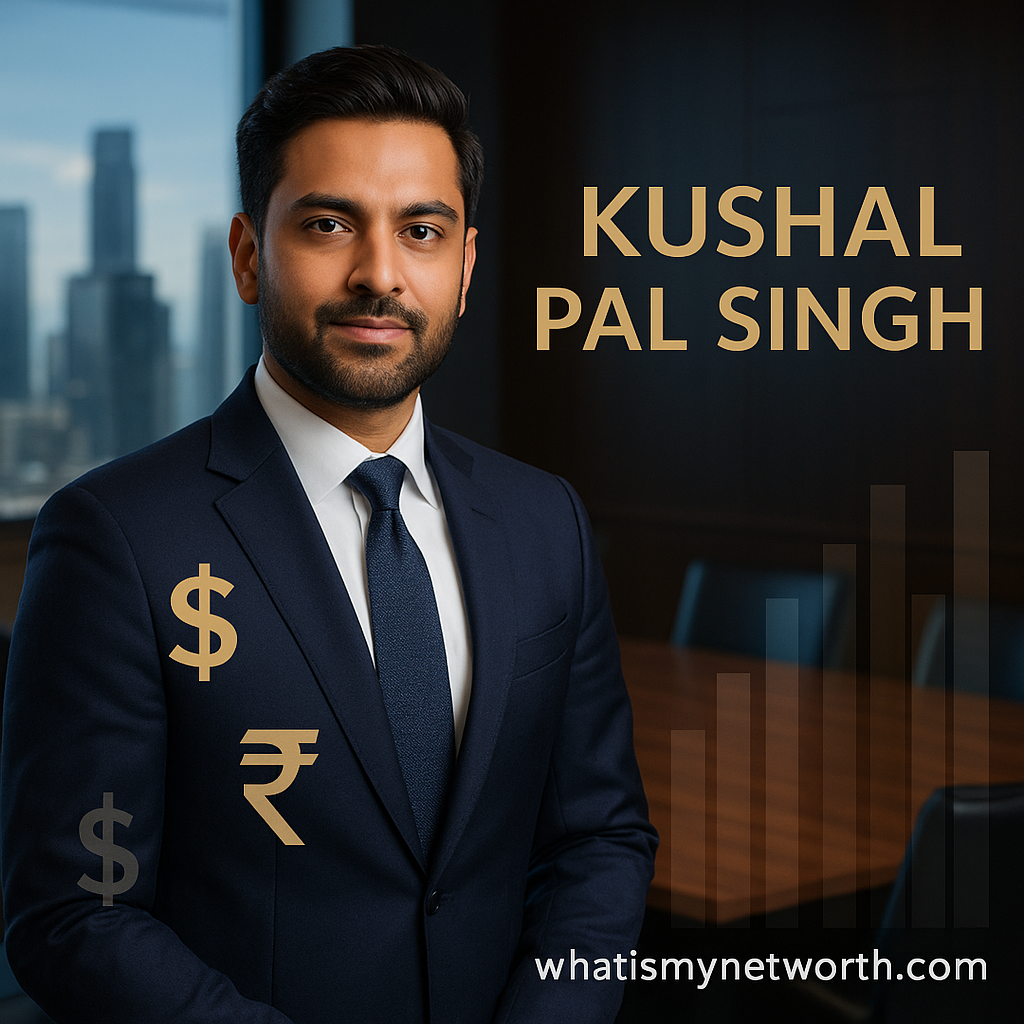
In the rarefied world of Indian billionaires, where tech moguls and industrialists often dominate headlines, the name Kushal Pal Singh stands as a monumental testament to a different kind of empire—one built not in the cloud, but quite literally, from the ground up. As the visionary behind DLF Limited, India’s largest real estate developer, K.P. Singh didn’t just construct apartments and offices; he forged the very skyline of modern India, transforming vast tracts of agricultural land into the country’s most prestigious addresses. For decades, his financial stature has been a barometer of the nation’s real estate health. As we step into 2025, his wealth represents more than just numbers on a balance sheet; it is the culmination of a lifetime of audacious vision, strategic land acquisition, and an unparalleled understanding of India’s urban destiny. Let’s explore the enduring financial empire of the man who, from his humble beginnings, built one of the most formidable and inspiring wealth stories in Asian business history.
Kushal Pal Singh Net Worth Overview
Kushal Pal Singh’s net worth is a direct reflection of his controlling stake in DLF Limited and the immense, often immeasurable, value of the land bank the company accumulated under his leadership.
| Parameter | Details |
|---|---|
| Net Worth (2025) | $13.5 Billion (Estimated) |
| Primary Income Sources | DLF Dividends, Asset Sales, Private Investments |
| Profession | Real Estate Tycoon, Former Chairman of DLF Ltd. |
| Nationality | Indian |
| Age (2025) | 94 Years |
The cornerstone of K.P. Singh’s wealth is his family’s significant shareholding in DLF Limited. While he has officially passed the baton to the next generation, his legacy and the wealth derived from it remain intact. His net worth is not fueled by a monthly salary but by the colossal dividend payouts from DLF’s profitability and the strategic sale of non-core assets. The years 2005 to 2008 were particularly financially rewarding, marked by DLF’s record-breaking Initial Public Offering (IPO) which catapulted him to the top of India’s rich lists. His wealth is less volatile than that of his stock-market-dependent peers, as it is anchored in prime real estate—a tangible, finite, and perpetually appreciating asset class, especially in a land-scarce country like India.
Early Life, Family, and Education
The story of Kushal Pal Singh is not one of inherited privilege in the way we might assume. Born on November 15, 1931, in Bulandshahr, Uttar Pradesh, he was raised in a military family. His father, Chaudhary Raghvendra Singh, was a decorated officer in the Indian Army. This environment instilled in a young K.P. Singh a sense of discipline, structure, and strategic thinking—qualities that would later define his business career.
Contrary to pursuing a military path, his academic inclinations led him to the prestigious Mayo College in Ajmer and later to the renowned Royal Military Academy at Sandhurst in the United Kingdom. This elite training ground for British Army officers was an unusual choice for a future real estate baron, but it provided him with a global perspective and a network of influential contacts. Upon graduation, he did, in fact, commission into the Indian Army’s elite Deccan Horse regiment, serving as a cavalry officer. However, destiny had a different plan. A chance meeting with American construction magnate William Zeckendorf opened his eyes to the transformative power of urban development. This encounter, coupled with an invitation from his father-in-law, Chaudhary Raghvendra Singh (who had by then founded the Delhi Land and Finance company), set the stage for a dramatic career shift. He left the army and entered the world of real estate, a decision that would alter the landscape of a nation.
Career Journey and Major Achievements
K.P. Singh’s career can be charted across distinct phases of visionary expansion.
The Foundational Years (1960s-1970s): When Singh joined DLF, it was a relatively small player in and around Delhi. His first major breakthrough was understanding the limitations of the Delhi Development Authority’s (DDA) master plan. He foresaw the urban sprawl and identified the potential of vast, underdeveloped areas in southern Delhi, particularly. He began the arduous task of acquiring land from farmers, often paying in cash and building trust through personal relationships—a strategy that was revolutionary at the time. This phase was about patient capital and strategic land banking.
Creating Gurugram: The Masterstroke (1970s-2000s): Singh’s most legendary achievement was the development of Gurugram (formerly Gurgaon). He transformed thousands of acres of arid land on the outskirts of Delhi into a world-class hub for corporate offices, luxury residential complexes, and shopping malls. He didn’t just sell plots; he created ecosystems. DLF provided the infrastructure—roads, water, electricity—making it an attractive destination for multinational corporations looking to set up shop in a liberalizing Indian economy. This self-contained city became the goose that laid the golden egg, generating unprecedented wealth for DLF and establishing K.P. Singh as the undisputed “King of Indian Real Estate.”
The IPO and Global Recognition (2000s-Present): After decades as a privately held company, DLF launched its IPO in 2007. It was one of the largest in Indian history, oversubscribed by nearly 3.5 times, and instantly made K.P. Singh one of the richest men in the world. In 2008, he was named the richest Indian by Forbes, with a net worth peaking at nearly $30 billion at the pre-2008 financial crisis peak. Despite the cyclical downturns in the real estate market, his and DLF’s dominance remained largely unchallenged. His official retirement and the succession planning that saw his son, Rajiv Singh, take over the reins marked the end of an era, but the empire he built continues to be the family’s primary source of wealth and influence.
Income Sources and Business Empire
K.P. Singh’s wealth is not diversified in the typical sense of a modern portfolio. It is deeply concentrated in the empire he built, with income flowing from several key channels within and around DLF.
DLF Dividends and Shareholding
The single largest source of his wealth. Through a network of trusts and investment entities, the Singh family continues to hold a decisive controlling interest in DLF Limited. As the company executes its large-scale residential and commercial projects, the profits generated lead to substantial dividend payouts to its shareholders. In a robust financial year, these dividends can run into hundreds of crores of rupees for the family, forming a steady and significant stream of passive income.
Strategic Asset Sales
A critical, albeit less frequent, source of capital infusion. DLF, under its strategy to reduce debt and focus on core development, has periodically sold off prime assets. This includes the sale of its rental arm, DLF Cyber City Developers Ltd (DCCDL), to institutional investors like GIC of Singapore. While these sales are company transactions, they unlock immense value, strengthen the balance sheet, and ultimately protect and enhance the family’s net worth tied to the company’s stock.
Personal Real Estate and Private Investments
Beyond the corporate entity of DLF, K.P. Singh and his family are believed to hold a substantial portfolio of personal real estate assets. These include ancestral properties, farmland, and perhaps even strategic personal investments in other land parcels or ventures. The exact details of this private portfolio are closely guarded, but it represents a significant, albeit opaque, component of their overall wealth. His investments have also extended to philanthropy, particularly through the DLF Foundation, which focuses on education, health, and skill development.
Kushal Pal Singh’s Assets, Luxury Cars, and Lifestyle
In contrast to the flashy, high-profile billionaires of the modern era, K. P. Singh has maintained a far more understated and low-key public persona. has always maintained a reputation for understated elegance and privacy. His lifestyle reflects old-money sensibilities rather than ostentatious displays of wealth.
- Real Estate Assets: The family’s primary residence is a sprawling, luxurious bungalow in Delhi’s Lutyens’ zone, one of the most expensive and exclusive addresses in the world. They also own palatial farmhouses on the outskirts of Delhi and likely have luxury apartments in DLF’s own premium developments in Gurugram and elsewhere.
- Car Collection: His car collection is classic and powerful, mirroring his personality. It is known to include several Rolls-Royces, Bentleys, and a fleet of high-end Mercedes-Benz and BMWs for daily use. These are not flashy supercars but vehicles that signify arrival and enduring luxury.
- Lifestyle: Singh is known to be a man of discipline, a trait carried over from his army days. His personal life is largely out of the media glare. He is an avid equestrian, a passion that connects back to his cavalry officer training. His wealth affords him access to the best healthcare, private travel, and a life of comfort that is seamless and effortless, rather than being a subject of public spectacle.
Net Worth Growth Over the Years
K. P. Singh’s wealth story unfolds alongside India’s economic reforms and the cyclical nature of the real estate sector, reflecting both opportunity and volatility over the years
| Year | Approx. Net Worth | Key Influencing Factor |
|---|---|---|
| 2005 | ~$5 billion | Pre-IPO estimates driven by the private valuation of DLF’s vast land reserves |
| 2007 | ~$30 billion | Surge following DLF’s landmark IPO and peak stock market optimism |
| 2009 | ~$10 billion | Sharp decline in the aftermath of the 2008 global financial crisis |
| 2015 | ~$7.5 billion | Prolonged real estate slowdown and concerns over corporate leverage |
| 2020 | ~$8.2 billion | Gradual recovery supported by asset sales and balance-sheet cleanup |
| 2025 | ~$13.5 billion | Post-pandemic housing upswing, strong project execution, and significant debt reduction |
The figures chart a clear arc—an explosive ascent, a painful downturn, and a measured comeback built on resilience. The 2007 high point stands out as an exceptional phase of market exuberance. What followed was a period of recalibration, during which DLF streamlined operations and refocused its strategy to emerge stronger. The rise toward 2025 is especially telling, highlighting the lasting strength of DLF’s underlying assets and the effectiveness of its long-term plan. It underscores how the platform established by Singh continues to create value across generations, even amid demanding economic conditions.
Philanthropy, Fitness, and Personal Life
K.P. Singh is married to Savitri Devi Singh, and together they have three children: two daughters, Pia Singh and Renuka Singh, and a son, Rajiv Singh, who is now the chairman of DLF. The family is known to be closely knit.
His philanthropic efforts, while not as publicly marketed as some of his contemporaries, are substantial. The DLF Foundation undertakes numerous initiatives in the areas of education, healthcare, and skill development, particularly in communities around their project sites. This reflects a sense of long-term commitment to the social infrastructure of the regions they develop.
Even at 94, Singh is known for his disciplined routine. His military background and passion for horse riding have contributed to a focus on fitness throughout his life. While he has stepped back from the public eye, he remains the patriarch and the guiding philosophical force behind the DLF empire.
Awards, Recognition, and Legacy
Kushal Pal Singh’s contributions have been recognized with some of the highest civilian and industry honors.
- Padma Bhushan (2010): Awarded by the Government of India for his contributions to trade and industry.
- Ernst & Young Entrepreneur of the Year Award (2007): Recognizing his transformative impact on Indian real estate.
- Lifetime Achievement Awards from various industry bodies.
His true legacy, however, is etched in steel and concrete. The skyline of Gurugram is his open-air museum. He demonstrated that real estate development could be a master-planned, holistic endeavor, not just a transactional business. He created a blueprint for urban development that has been emulated, but never quite matched, across India. His story is a classic case of long-term vision triumphing over short-term gains.
Controversies and Public Perception (Balanced View)
No story of such scale is without its controversies. DLF and K.P. Singh have faced their share of scrutiny.
- Land Acquisition Practices: The methods of acquiring large land parcels from farmers in the early days have been questioned by some, though it’s widely acknowledged that he paid fair prices at the time and transformed the economic destiny of those regions.
- Regulatory Challenges: DLF has been involved in legal and regulatory tussles, most notably a case with the Competition Commission of India (CCI) and a temporary ban by SEBI, the market regulator, on the company and its top executives from accessing capital markets (which was later overturned by the Securities Appellate Tribunal).
Despite these challenges, K.P. Singh’s public perception remains that of a visionary builder. He is admired for his integrity in business dealings, his strategic acumen, and for building an institution that has become synonymous with quality and trust in Indian real estate.
Future Plans and Upcoming Projects
While K.P. Singh is retired, the future of his wealth is inextricably linked to DLF’s trajectory under his son’s leadership. DLF’s future plans are ambitious:
- The DLF 5 Project in Gurugram: A massive 30-acre ultra-luxury residential project, one of the most ambitious in the company’s history, which is expected to generate billions in revenue.
- Continued Focus on High-Margin Residential Projects: Leveraging their brand to launch premium housing societies across key metros.
- Commercial and Retail Expansion: Further developing their rental arm to ensure a steady, annuity-like income.
The successful execution of these projects will be the primary driver of the Singh family’s net worth in the coming years, ensuring that the empire K.P. Singh built continues to grow and evolve.
Interesting & Lesser-Known Facts About Kushal Pal Singh
- Cavalry Officer: He is one of the few billionaire businessmen in the world who started his career as a commissioned cavalry officer in the army.
- The Zeckendorf Influence: His passion for large-scale development was ignited by American builder William Zeckendorf, who believed in creating “cities within cities.”
- Master Negotiator: He was known for personally negotiating land deals with farmers, often carrying suitcases of cash to build trust and close deals on the spot.
- A Man of Routine: Even at the peak of his career, he maintained a disciplined daily routine, often starting his day very early.
- Philanthropic Focus: A significant portion of his personal wealth is believed to be channeled into private philanthropic trusts focused on education.
- Avid Equestrian: He maintained a personal stable of horses for many years, a passion that connected him to his military past.
- Global Recognition: In 2008, his net worth was so vast that he was ranked among the top ten richest people in the world by Forbes.
FAQs About Kushal Pal Singh
What is Kushal Pal Singh’s net worth in 2025?
By 2025, Kushal Pal Singh’s personal fortune is estimated at around $13.5 billion. The bulk of this wealth comes from his family’s long-standing ownership and control of DLF Limited.
How did Kushal Pal Singh build his wealth?
Singh created his fortune by transforming DLF into India’s most influential real estate company. His most defining achievement was turning what was once largely undeveloped land into Gurugram, now one of the country’s key corporate and residential centres.
Where does his income mainly come from?
His earnings are largely tied to DLF through dividends, carefully planned asset sales, and gains from privately held real estate investments.
Has Kushal Pal Singh retired from business?
Yes. He has stepped away from active management at DLF. Day-to-day leadership is now handled by his son, Rajiv Singh, who serves as Chairman and oversees the company’s operations.
Which project made him famous?
The development of Gurugram (earlier known as Gurgaon) remains his most celebrated and transformative contribution to India’s urban landscape.
What is known about his taste in luxury cars?
Singh is believed to favor traditional, high-end automobiles, with reports often mentioning Rolls-Royce and Bentley models in his collection.
Did he have a military career?
Yes. Before entering the real estate world, Singh served as an officer in the Indian Army’s Deccan Horse regiment after completing his training at the Royal Military Academy, Sandhurst.
Conclusion
Kushal Pal Singh’s financial journey is a masterclass in patience, vision, and the transformative power of land. In an era of rapid digital wealth creation, his story stands as a powerful reminder of the enduring value of tangible assets and city-building. From a cavalry officer to the architect of India’s modern urban landscape, his path was unique and unparalleled. The fluctuations in his net worth over the years tell a story of market cycles, but the underlying foundation—the prime land bank and the brand value of DLF—has remained unshakable. As we look at his estimated $13.5 billion net worth in 2025, it is not just a measure of monetary success, but a valuation of a legacy. Kushal Pal Singh proves that with a clear vision, unwavering conviction, and the discipline to see it through, one can build not just a fortune, but a lasting physical legacy that shapes the future of a nation.
Also Read: Top Richest Real Estate Tycoons in 2025
